According to the book What is Art Criticism And Why We Do it, the author T.L. Anderson, justifies art criticism as a way to reflect on human values and understanding. He presents the idea of art being “representational” in a way that the art work does not give us and explanation of the artists life or feelings, rather “presenting us with a feeling, a visual worldview, suggesting or implying what is or what may be but not giving an explanation.”[1] Based on this explanation, artists suggest and give way to the mind to interpret and feel different things. These cues also suggest many things about an artist’s historical background and events that inspired them to paint and create their works. Spanish artist Pierre Daura, painted and depicted most of his life and situation in all of his colorful and vivid canvases. Born in Minorca, Spain on 1896, Daura was influenced by his life in Spain and later his move to the United States. In one of his most prominent paintings Mother and Daughter, created in 1970, the painter evokes emotion, biographical context, and an enormous amount of opportunity for the viewer to examine and interpret the painting in many different ways. In this paper, I’m going to be a critic for Pierre Daura’s paitnintg folling T.L. Anderson and Milbranst’s genral structure for art criticismMother and Daughter,
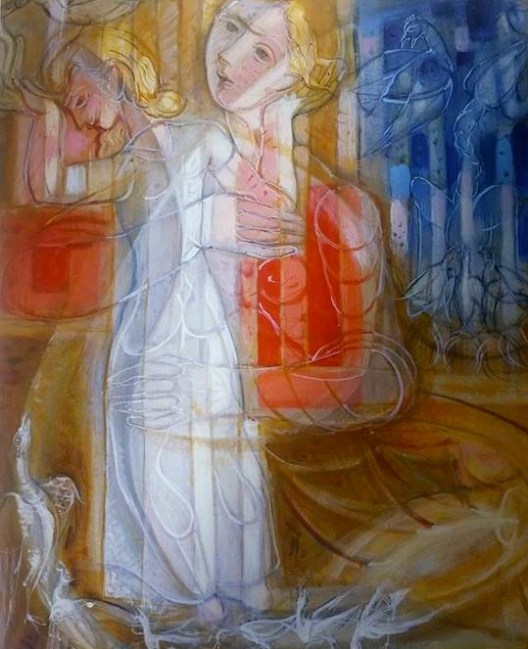
The Mother and Daughter is exhibited in the second floor of the Georgia Museum of Art next to two other pieces of his series Death with Cane. The description of these two pieces done by Georgia Museum of Art’s curator Dr. Lynn Bowland says the paintings are a “recollection of a happy past from a fired, sad, and determined Daura.”[2] The placement near these two other paintings immediately evokes a feeling of nostalgia and sadness to the painting. After viewing the painting Death with Cane, the viewers eye is directly attracted to 27 9/16 x 23 ¾ inches Mother and Daughter painting which is oil on canvas. The background which is a dirty yellow awakens a feeling of desolation and a lost place; immediately the solemnness of the dirty yellow is cut by bright red, blue, and white which give a feeling of hope. At first it simply looks like a delineated silhouette of a mother holding a girl. The mother embracing the child reminds the viewer of love, affection, and security. Additionally, once we are past the silhouette of the mother, one can notice that the fourteen blue and white doves surrounding the woman, which arouse the viewer to peacefulness and calmness. The description of the painting makes it justice as the curator describes it as a “tender, smiling embrace, evoking unity of souls.”[3] The painting had such an impact on me that it reminded me of my mother and the affection she has for me despite our fights and problems. The use of colors, silhouettes, and form in this painting leads to the post-reaction of the work of art.
The colors used in the canvas are the 3 primary colors: blue, yellow, and red with the additional use of white for the dominating central image of the child. The artist seems to have painted a background before anything else majorly consisting of an earthy dirty yellow which is almost brown in certain parts of the painting; the austere yellow evokes dryness and nostalgia, but is immediately contrasted with the vivid use of red, blue, and white. It seems that Daura might have waited a couple of days for the background to dry out and then used different hues of the background color to do some vertical lines that are also part of the upper half of the background. After this, the painter seems to have used white to draw the mother-daughter silhouette and the doves surrounding the image. Moreover, the mothers embracing arms and clothing are red; the upper right corner is painted with a rich blue, which seems to depict a small piece of sky in the painting. Lastly, the center image and the doves are all either drawn or painted in white. In the lower left corner and the upper right corner an adult dove which seems to be the mother is followed and praised by baby chicks; the image of these two doves directly reflects on the mother and daughter’s bond above and next them as to confirm the beautifulness of motherhood even in animals and nature.
The central focus of the canvas is a child embraced by a mother. Daura’s piece seems to be more formalistic than expressionist because its central image is aesthetic as it concentrates on the beauty of mother-daughter. Moreover, the forms are more objective than subjective since the drawings are straightforward of humans and animals. Although its very formalistic, it has some elements of abstraction as the forms of the humans and the animals are simply silhouetted through shapes and lines. Right off as viewers we know that Pierre Daura wants us to have a feeling of love and tenderness because of the mother and child portrayed. As simple as this image may seem, there is much mystery and depth to the colors and forms used by the artist. The artist tricks the viewer into thinking we are seeing a sad image because of the dirty and dull color of the yellow in the background, but as we look deeper into the painting, we notice the tranquility evoked by the mothers facial features. Adelheid M. Gealt, director of the Indiana University of Art explains this canvas was done once the painter “faced a life without his wife Louise.”[4] At first sight it seems like a sad painting, but then the colors and expressions make it more cheerful than melancholic. Unlike the paintings surrounding this canvas which facial expressions seem worried and disturbed, his wife’s Louise’s facial expressions seems calm.
Guided by the T.L. Anderson and Milbrandt’s guides to art criticism, the most important part of it is interpretation, which comes after all of the information and description about the painting given above. Based on the artist’s biographical information in William S. Rasmussen essay published for the Virginia Historical Society, his daughter Martha and wife Louis were essential to his inspiration as an artist, he “celebrated his love for his wife”[5] in thousands of sketches and paintings of both of them. Mother and Daughter, greatly reflects on the closeness and relevance his wife and daughter had in his life. In this painting he almost depicts his wife as heroic as the Virgin Mary; Sandro Botticelli’s The Madonna of the Book has many similar features to Daura’s painting. In Botticelli’s painting, the Virgin Mary’s red dress and the halo around her and Jesus are imitated in both the rounded blonde hair in both women and in Louis’ red shirt. Additionally, baby Jesus is naked just as Martha is. The doves, which are a symbol of purity and peace, elicit a feeling that the artist is trying to reconcile with the fact that his wife is dead by surrounding her by biblical animals like doves, which live as one with heaven and the skies. Just as the Virgin Mary contended with the death of Jesus, it seems like Daura is trying to accept the death of his wife by painting a tribute to her. The artwork does not depict a dreadful death, but rather remembers her as a graceful mother who cared and embraced their daughter Martha. Adelheid Gealt describes the series as a “recollection of a happy past”[6], this description seems appropriate. Unlike artists who paint dark and mournful images, Daura celebrates life through motherhood. Such is the celebration of motherhood, that even the doves that accompany the image seem to bring with them baby chicks that add to life.
After diving into the paintings complex and rich content I found much more meaning than I expected to find. Unlike the other painting of the artist that show the artists dexterity, this one isn’t delicate in detail or Daura’s finest work. Compared to Daura’s other works, which mostly consist of realistic portraits and landscapes, this painting stood out to me because of the feelings it evoked and not because of the neatness and technique. The canvas truly gives a feeling of love and tenderness from the harmony between mother and child. Not only did the art work remind me of my mother but it truly resembles and makes one think of Jesus and the Virgin Mary. The feeling of restlessness because of the abrupt change in color and the contrast in the background is quickly eased as the eye rests in the white and peaceful centerpiece in the canvas. Not only does Daura cherish and celebrate nurturing from the mother but he also honors life in general. In a way the artist is trying to tell everyone to live life to the fullest by remembering memories lived with his now gone wife. The reminiscence of his wife nurtures the artist’s imagination and inspires him to paint not only happy memories, but awakens him in a moment of grieve for his wife.
Aa the authors of What is Art Criticism And Why We Do it quote, “art reflects the artist’s view of life, whether or not the artist intended to do so”[7]. The paintings and work of Spanish artist Pierre Daura directly comply with the previous quote. Journalist Yael Ksander at Indiana Public Media, agrees that “no matter what stage his life is in, there’s a relevance creatively speaking to his own existence with his family. And that you don’t see so often”[8]. This idea is so true that his paintings seem to be almost autobiographical with his paintings of his daughter at every age and landscapes of his location at the time. The analysis and the thought process of analyzing the artists pieces have made me realize the amazing qualities of Daura. His whole collection is a perfect example of an artists evolution from realism to abstraction, and of an artist who’s life truly inspired his paintings. For that reason, I believe this artist should be praised because of his ability to produce fine and detailed pieces of work, as well as abstract pieces. More importantly, is his ability to arouse viewers emotions, sensations, and appraise towards his works.
 HealthyEspo